Taking notes has never been easier.
We save articles to read later, write down ideas during meetings, capture screenshots, and record thoughts on our phones. A useful sentence can become a note in seconds. An entire webpage can be saved with a single click.
Yet many of these records are never opened again.
A note that seemed important on Monday may be forgotten by Friday. A useful article disappears into a collection of bookmarks. Meeting notes remain untouched until someone asks a question we know we answered months ago.
The problem is not always that we take too many notes. It is that saving information and making information useful are two different activities.
Understanding that difference is the first step toward building a collection of notes that does more than grow.
Taking Notes Feels Productive, but Storage Is Only the Beginning
There is a satisfying sense of progress in capturing information.
When we save an article, we no longer need to worry about losing it. When we write down an idea, we can stop trying to hold it in our working memory. When we record a meeting, we create something that can be consulted later.
These are genuine benefits.
External records allow us to preserve information beyond what we can remember at a particular moment. They reduce our dependence on memory alone and make it possible to return to details after the original experience has passed.
This is one reason record-keeping has remained valuable across very different technologies.
Ancient administrative records helped people track transactions and obligations. Personal notebooks allowed readers and scholars to preserve passages and observations. Digital tools now let us capture information with far less effort.
But the ease of capturing information creates a new difficulty.
The number of things we can save grows faster than our ability to review and use them.
Consider someone researching a new subject.
They save ten articles, highlight several passages, and write down a few promising ideas. By the end of the session, they have collected plenty of material.
But what have they learned? That depends on what happens next.
If the articles remain unread and the highlights have no explanation, the collection may be difficult to use. The information has been preserved, but the research process has not necessarily moved forward.
Saving something can be a useful first step. It is not the same as understanding it. This distinction matters because a note collection can become larger without becoming more valuable.
Why Saved Notes Become Difficult to Find and Understand
A note is usually created in a particular context.
We know what we are thinking about, what problem we are trying to solve, and why a piece of information matters.
Later, much of that context may be missing.
Imagine writing the following note during a meeting:
Ask about the revised timeline.
At the time, the meaning is obvious.
You know which project is being discussed, who should be asked, and what changed. Three months later, the note may be nearly useless. Which timeline? What revision? Who was responsible?
The words have been preserved, but the situation that gave them meaning has faded.
This illustrates one of the most common problems with notes: we often write them for our present selves rather than our future selves.
A Note Without Context Depends on Memory
A useful note should contain enough information to make sense when the original situation is no longer fresh.
For example:
Website redesign meeting, October 8: Ask the project manager whether the revised launch timeline includes the additional accessibility review.
The second version is longer, but it is easier to understand without reconstructing the entire meeting.
Not every note needs this much detail. A quick reminder may be sufficient for something you will act on within an hour. The important question is how long the note needs to remain useful.
Storage Location Is Not the Same as Retrieval
Another difficulty is finding the note at the right moment. A document may be carefully saved in a folder, yet difficult to retrieve because we cannot remember its title or location.
A note about improving website navigation might be stored under “Design,” “Marketing,” “Research,” or a particular project.
Each location could make sense. But when we need the information later, we may search for a different concept than the one we used when saving it.
This is why folders alone cannot solve every information-retrieval problem. Descriptive titles, searchable text, meaningful keywords, and connections between related notes can all help.
The goal is not to create a perfect classification system. It is to make useful information easier to recover when the need arises.
A Useful Note Preserves Meaning, Not Just Information
A collection of copied passages is not necessarily a collection of useful knowledge.
Suppose you read a research article about retrieval practice—the process of actively recalling information from memory. Studies suggest that this approach can support long-term retention more effectively than simply rereading the same material.
You highlight a paragraph and save it. Weeks later, you discover the highlight but cannot remember why you thought it mattered.
Now consider a different approach.
Instead of preserving only the passage, you add two short sentences:
Main idea: Trying to recall information can support learning, rather than relying only on repeated reading.
Why I saved this: I want to test whether short recall questions help me remember research material for future articles.
The second note contains more than information from the source. It also preserves your interpretation and intended use. That makes it easier to return to the idea and decide what to do with it.
The Value of Writing in Your Own Words
Rewriting an idea in your own words can help reveal whether you understand it.
If you cannot explain what a passage means, you may need to examine it more carefully.
This does not mean every quotation should be paraphrased.
Sometimes the exact wording matters, particularly when recording a historical source, legal text, or important definition. In those cases, preserving the original wording and source is essential.
But adding a brief explanation can help distinguish the source’s claim from your own interpretation.
A practical note might include three elements:
What is the information?
A quotation, observation, fact, question, or idea.
Why does it matter?
The reason you considered it worth preserving.
When might it be useful?
A project, decision, question, or future task to which it relates.
These are not mandatory fields for every note. They are questions that can help when a record needs to remain useful beyond the moment it was created.
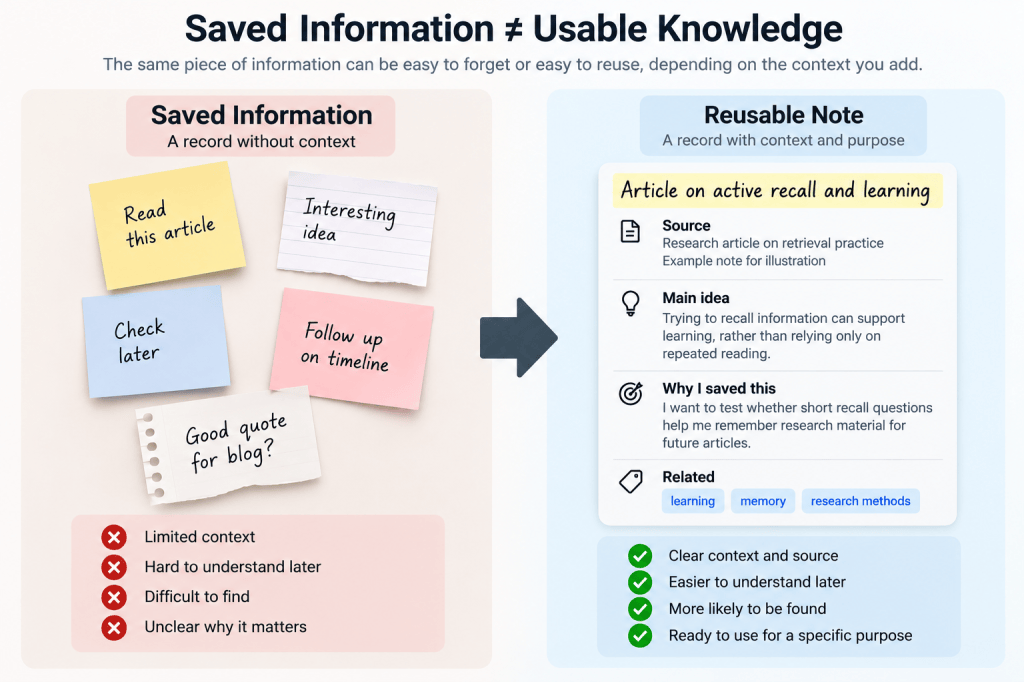
A short note with clear context can be more useful than a long document that requires extensive interpretation.
The objective is not to write more.
It is to preserve enough meaning to make the information usable again.
Notes Become Valuable When We Return to Them
Many note-taking systems emphasize capture. They make it easy to add new information, but they do not necessarily encourage us to revisit what we have already collected.
Over time, this can turn a note collection into a one-way archive. Information enters, but rarely comes back out.
A more useful approach treats notes as material for future thinking and action.
Review Notes When They Serve a Purpose
Not every saved item needs to be reviewed regularly.
A restaurant address may be useful only once. A temporary reminder may become irrelevant after a task is completed.
Trying to revisit everything can create unnecessary work.
Instead, review notes when they relate to an active question or project.
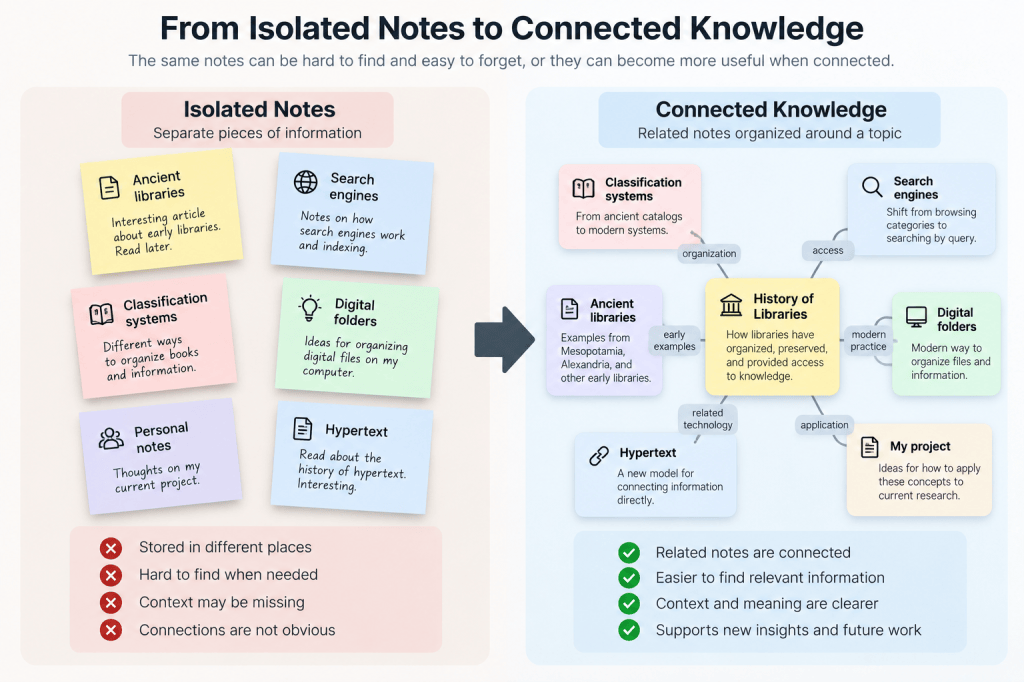
For example, someone preparing an article about the history of libraries might revisit notes about ancient archives, book catalogs, classification systems, and digital search.
Those notes were created at different times.
Bringing them together for a specific purpose allows the writer to compare ideas and recognize relationships that were not obvious when each note was first saved.
This is a form of reuse. The notes are no longer simply records of past reading. They become resources for new work.
Connections Make Notes Easier to Reuse
Some information becomes more valuable when connected to other information. A note about library catalogs might connect to another about digital folders. Both concern the organization of records, even though they describe different technologies.
A third note about search engines might reveal another connection: the shift from locating information through predefined categories to retrieving it through queries.
These relationships do not need to be complicated. A simple reference such as “Related: history of library classification” can be enough to preserve a useful connection.
Digital tools may support clickable links between notes, but the underlying principle is older than computers. People have long used indexes, cross-references, and personal notebooks to connect information across separate records.
Hypertext made many of these connections directly navigable in electronic systems.
The deeper idea remains the same:
A note becomes more useful when we can place it in relation to something else we know.
From Forgotten Notes to a Personal Knowledge System
The term second brain is commonly used in personal knowledge management to describe an external system for capturing, organizing, retrieving, and using information. It is a practical approach to managing knowledge rather than a single, scientifically standardized method.
The idea is appealing because human memory has limits. We cannot reliably remember every useful passage, conversation, observation, or idea we encounter.
External records can help.
But a second brain should not be confused with a collection that simply stores everything. A large archive may contain thousands of notes and still be difficult to use.
What matters is whether the system helps us recover relevant information, understand why it matters, and apply it to a current problem. This does not require a particular app.
A paper notebook with a clear index may be useful. A folder of well-named documents may work for a defined project. A digital knowledge-management tool may offer additional benefits through search, tags, and links.
Different tools support different ways of working.
The important principles remain relatively stable:
A record should be understandable when we return to it. Important information should be retrievable. Related ideas should be connectable. Notes that are no longer useful should not demand endless attention.
Modern AI tools introduce another possibility: helping people search, summarize, and work with collections of recorded information.
Yet AI does not eliminate the importance of context.
If a collection contains unclear, outdated, or poorly sourced material, automatically retrieving that material does not guarantee a reliable answer. AI-generated summaries and responses may also introduce errors, so important information still needs to be checked against its original sources.
The quality of a knowledge system still depends partly on the quality and organization of the information within it.
Start With One Question, Not a Complete System
If you have hundreds of notes you rarely revisit, there is no need to reorganize everything immediately.
Choose one question you are currently trying to answer. Then search your existing notes for information that might help. As you find relevant material, make small improvements.
Give an unclear note a descriptive title. Add a sentence explaining why it matters. Connect it to another useful record. Remove an item that no longer serves a purpose. This approach starts with actual use rather than an imagined perfect system.
It also helps reveal which organizational features you genuinely need. Someone who frequently searches for specific facts may benefit most from better titles and searchable text. Someone developing complex ideas over time may benefit from linking related notes. Someone managing recurring projects may need a consistent way to review active material.
The best system is not necessarily the most elaborate. It is the one that helps recorded information return to your attention when it can make a difference. Taking notes is only the beginning of that process.
The real value appears when a record helps us remember something important, understand an idea more clearly, make a decision, or create something new.
The next challenge is learning how to organize notes so that useful information can be found again.
FAQ
Is It Bad to Take Notes That I Never Read Again?
Not necessarily. Some notes are temporary reminders or records that only need to be consulted if a specific situation arises. The problem is not that every note goes unread. It is when information you expected to reuse becomes difficult to find or understand.
Should I Organize All My Old Notes Before Taking New Ones?
Usually, there is no need to reorganize an entire archive at once. Start with notes related to an active project or question. Improve their titles, context, and connections as you use them. This helps you develop an organizational approach based on real needs rather than spending excessive time maintaining a system.
Do I Need a Second-Brain App to Make My Notes Useful?
No. A second brain is better understood as an approach to using external records than as a requirement to use one particular application. Paper notebooks, ordinary documents, and dedicated note-taking tools can all support useful knowledge management. Clear context, reliable retrieval, and meaningful reuse matter more than the complexity of the software.
Sources and Further Reading
Association for Psychological Science — Improving Students’ Learning With Effective Learning Techniques (2013)
Roediger, H. L., & Karpicke, J. D. (2006) — Test-Enhanced Learning: Taking Memory Tests Improves Long-Term Retention
Clark, A., & Chalmers, D. (1998) — The Extended Mind
Forte Labs — Building a Second Brain: An Overview

