For centuries, people organized recorded knowledge by giving it a place. Libraries arranged books on shelves. Catalogs described where those books could be found. Personal notebooks collected passages under headings. Later, computers organized digital files into directories and folders.
These systems made growing collections easier to manage. But they also raised a familiar problem.
What happens when a piece of information belongs to more than one subject?
A research note about ancient libraries might also relate to classification, memory, and digital search. Placing it in a single folder does not fully represent those relationships.
Hypertext offered a different approach.
Instead of requiring readers to follow only a fixed sequence or location, hypertext allowed information to be connected through links.
A reader could move from one document or passage to another because the ideas were related, not simply because the documents were stored together.
This change helped reshape how people navigate information—and eventually became one of the foundations of the World Wide Web.
Vannevar Bush Imagined Records Connected by Association
In 1945, American engineer and science administrator Vannevar Bush published an influential essay titled As We May Think in The Atlantic.
Bush was concerned with a problem that remains familiar today: the growing volume of recorded knowledge.
Scientific research was producing information faster than individuals could easily organize and retrieve it.
Bush imagined a device he called the Memex, a personal information system that would allow someone to store and consult a large collection of documents. The Memex was a proposal rather than a functioning personal computer.
Bush described a system based on technologies such as microfilm, viewing screens, and mechanical controls. Its most important feature was not simply its storage capacity.
It was the idea of creating connections between records.
Bush proposed what he called associative trails.
A user could connect one item to another and preserve that relationship as a path through information.
Imagine reading a document about the history of printing. One passage might lead to a record about paper production. Another might connect to the history of libraries. A third could point toward modern information retrieval. These records would not need to sit beside one another in a single physical arrangement. The connection itself would help the user move between them.
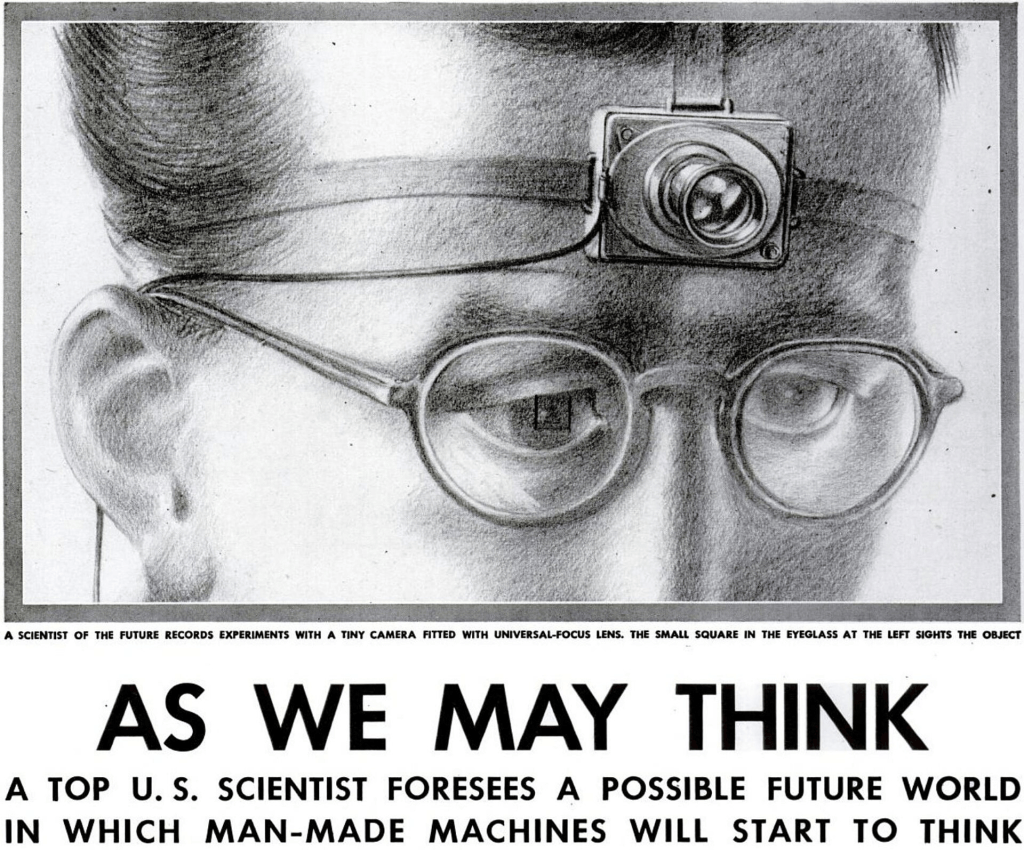
Bush did not invent the modern hyperlink or build the World Wide Web. His Memex was also not identical to later digital hypertext systems.
Nevertheless, his essay became an influential reference point for researchers exploring ways to organize information through associations. The central insight was that relationships between records could become part of the system used to retrieve them.
Ted Nelson Gave Hypertext a Name
During the 1960s, computer researcher and writer Ted Nelson developed ideas about nonlinear electronic documents.
Nelson introduced the term hypertext in the mid-1960s to describe text that could be connected and navigated in ways that did not require a single predetermined reading order.
Traditional printed text often encourages a sequence. A reader starts at one page and continues to the next.
Of course, people have always moved around printed books using indexes, footnotes, and cross-references. Hypertext did not invent the idea of referring readers elsewhere.
What changed was the possibility of making those connections directly navigable within a computerized information system. Instead of locating another passage manually, a reader could follow a link.
Nelson’s broader vision included ideas about interconnected documents, references, and the preservation of relationships between texts.
His long-running Project Xanadu explored possibilities that differed in important ways from the web that later became widespread.
For example, Nelson placed considerable emphasis on persistent connections, document relationships, and the problem of referencing material across changing versions.
These ideas remind us that hypertext was never limited to the familiar blue links of web pages. It was part of a broader effort to reconsider what electronic documents could become. A document did not have to be understood only as a self-contained object. It could also be part of a network of related information.
Early Hypertext Systems Made Links Interactive
The development of hypertext was not limited to theoretical proposals. During the 1960s, researchers began demonstrating interactive computing systems that allowed users to work with connected information.
One important example was Douglas Engelbart’s oN-Line System, usually known as NLS. Engelbart and his research team developed NLS at the Stanford Research Institute, now SRI International.
Their work focused on improving how people could use computers to work with information, communicate, and solve complex problems.
In December 1968, Engelbart demonstrated NLS at the Fall Joint Computer Conference in San Francisco.
The presentation later became widely known as the Mother of All Demos.
It showed technologies that were remarkable for the period, including interactive text editing, pointing-device interaction, collaborative work, and ways to navigate linked information.
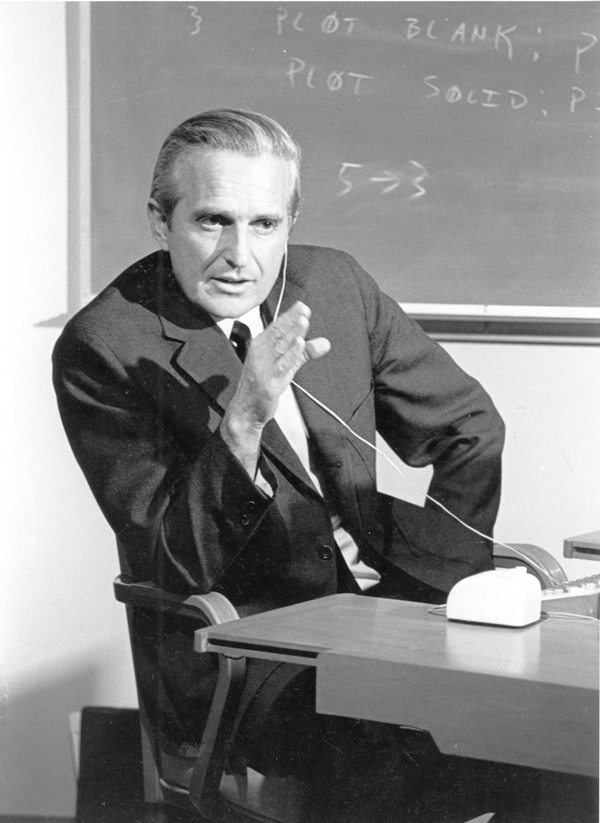
The demonstration mattered because it showed that a computer could be more than a machine for calculating results or processing batches of data. It could become an interactive environment in which people developed, revised, and connected ideas.
Other researchers also explored hypertext through systems such as Andries van Dam’s Hypertext Editing System and later FRESS at Brown University.
These projects did not all use the same technical approach. Some focused on editing and navigating linked documents. Others emphasized collaboration, document structure, or different forms of interaction.
Together, they demonstrated that nonlinear information systems could be built and used. The history of hypertext was therefore not the story of one inventor producing a finished technology. It was a developing field of ideas, experiments, and working systems.
The World Wide Web Brought Hypertext to a Global Network
By the late 1980s, computers were increasingly connected through networks. But sharing information across different machines and systems remained difficult.
At CERN, the European particle physics laboratory, Tim Berners-Lee proposed a system for managing and sharing information among researchers.
His March 1989 proposal, Information Management: A Proposal, addressed the challenge of connecting information distributed across projects, people, and computer systems.
The solution drew on hypertext ideas.
Rather than requiring every document to fit into one centralized organizational structure, information could be connected through references that users could follow.
Berners-Lee and collaborators developed the foundations of the World Wide Web, including technologies such as HTML, HTTP, and URLs.
The first web server and browser were developed at CERN around 1990, and the web became available to a wider community in 1991.
The World Wide Web was not the first hypertext system.
Its importance lay partly in combining hypertext with network technologies and an architecture that allowed information to be accessed across different computers.
A document could link to another document stored on a different server. The reader did not need to know the underlying file structure of every computer involved.
A link provided a route.
That made it possible for independently maintained collections of information to become part of a much larger connected environment.
The web’s growth would depend on many later developments, including browsers, standards, infrastructure, and contributions from researchers and organizations around the world.
But the basic idea was powerful.
Information could be connected across boundaries without requiring every document to live in the same collection.
From Hypertext to Connected Knowledge
Today, hyperlinks are so familiar that they can seem almost invisible. We follow them in websites, online encyclopedias, digital documents, and research databases. But the principle extends beyond web browsing.
Modern note-taking and knowledge-management systems often allow people to connect one note to another. A note about printing might link to a note about paper, which in turn links to a note about libraries.
These connections provide another way to navigate information.
A folder answers a question about location: Where is this record stored?
A link answers a different question: What other record is related to this one?
Both questions matter. Folders can provide structure. Search can help retrieve information through words or metadata. Links can preserve relationships that might otherwise be forgotten. These methods are complementary rather than mutually exclusive.
A linked system also has limitations.
Links can become outdated. Relationships can be unclear. Creating many connections does not automatically produce understanding. A useful link needs a reason to exist.
Nevertheless, hypertext changed what people could expect from recorded information. Documents no longer had to be experienced only as separate objects arranged in a predetermined order.
They could become parts of a navigable network.
This development connects the history of record-keeping with the modern idea of a second brain: an external system that helps people preserve, retrieve, and work with information beyond what they can remember unaided.
Digital notes, linked documents, and AI-assisted knowledge tools build on different technologies, but they share an enduring challenge.
How can recorded information become useful again in a new context?
From clay tablets and manuscripts to printed books, file systems, and hypertext, the history of records has involved more than finding new places to store information.
It has also involved developing better ways to organize, retrieve, and connect what we know. And as digital collections continue to grow, the next challenge is increasingly personal:
How do we turn the information we collect into knowledge we can actually use?
FAQ
Did Vannevar Bush invent hypertext?
Not in the modern technical sense. Bush’s 1945 Memex proposal described associative connections between records and influenced later thinking about linked information. The term hypertext was introduced by Ted Nelson in the 1960s, while working hypertext systems were developed through several research projects.
What is the difference between hypertext and the World Wide Web?
Hypertext is a way of organizing and navigating information through links. The World Wide Web is a networked information system that uses hyperlinks along with technologies such as URLs, HTTP, and HTML. Hypertext systems existed before the web, and not all hypertext systems are websites.
Are linked notes the same as hypertext?
Linked notes use principles associated with hypertext because they allow users to move between related pieces of information. However, note-taking applications differ in how they store links, manage relationships, and support navigation. Creating links between notes also does not automatically make those notes useful; the relationships need to be meaningful.
Sources and Further Reading
The Atlantic — As We May Think, by Vannevar Bush (1945)
Computer History Museum — The Mother of All Demos
SRI International — The Mother of All Demos
CERN — The Birth of the Web
CERN — Information Management: A Proposal (1989)
World Wide Web Consortium (W3C) — A Little History of the World Wide Web

