A library catalog helps people find knowledge that has already been collected. But individuals have long faced a different problem: how can they remember, organize, and return to information that matters to them?
A useful idea might appear during a conversation. A passage in a book might be worth remembering. An observation made during work might become important months later.
Human memory alone cannot reliably preserve every detail.
Personal notebooks offered a practical response. They gave people a place to collect information beyond the immediate moment and return to it when needed.
Yet notebooks were never used for only one purpose. Across different periods, people used them to manage daily activities, preserve quotations, record observations, reflect on experiences, and develop ideas.
The history of personal notebooks is therefore not simply the history of writing things down. It is also the history of learning how to turn scattered information into something useful later.
Personal Records Existed Long Before Modern Notebooks
People kept personal and practical records long before the familiar bound paper notebook became common.
In ancient societies, writing could support activities such as trade, household management, correspondence, and education. Individuals and families preserved letters, accounts, and other documents that served purposes beyond large institutional archives.
The materials varied. Clay tablets, wooden writing tablets, papyrus, parchment, and eventually paper all provided ways to record information.
Not all of these records resembled a modern notebook. Some were individual documents. Others were collections of texts or records kept together for practical reasons.
What they shared was a basic function: they allowed information to exist outside a person’s memory.
A merchant might need to remember an obligation or transaction. A student might copy material for practice. Someone exchanging letters could preserve information that would otherwise disappear after a conversation.
These uses remind us that personal record-keeping did not begin with a single invention. It developed through many ordinary needs.
The bound notebook eventually brought an important convenience. Instead of maintaining many separate writing surfaces, a person could keep multiple entries together in a portable object.
This made it easier to accumulate records over time.
But collecting information was only the beginning. The next challenge was deciding what deserved to be recorded.
Commonplace Books Turned Reading into a Personal Collection
One influential tradition in the history of personal notebooks was the commonplace book.
Commonplace books became especially prominent in European education and intellectual life during the Renaissance and early modern period, although the practice drew on older traditions of collecting and organizing useful passages.
A commonplace book was not necessarily a diary.
Rather than recording the events of each day, its owner might copy quotations, arguments, examples, proverbs, or observations from different sources.
The purpose was to preserve material that could be useful in future reading, writing, conversation, or study.
Imagine a reader encountering an interesting passage about friendship.
Instead of relying on memory, the reader could copy it into a notebook under a heading such as “Friendship.”
Later, another passage on the same subject could be added.
Over time, the notebook would become a personal collection of material organized around the reader’s interests.
This practice involved more than copying.
The reader had to notice something worth keeping, select it, and decide where it belonged. That decision gave the recorded passage a place within a larger structure.
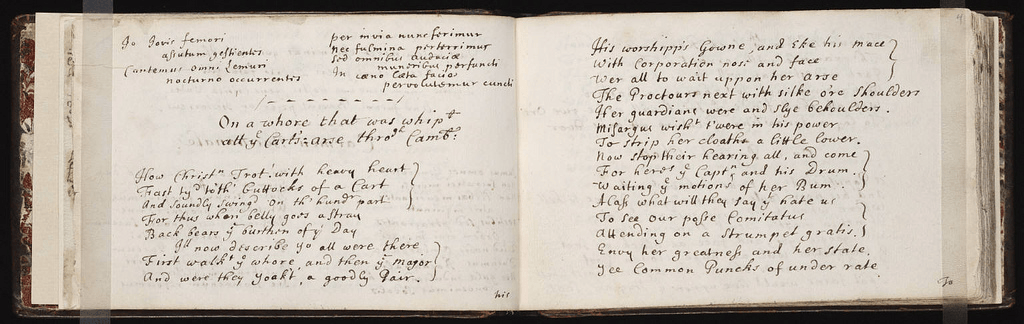
Commonplace books also reveal an important difference between storing information and organizing it.
A notebook filled with quotations might preserve valuable material, but without headings or another way to find entries, it could become difficult to use.
Organizing passages by topic created a route back to them.
The notebook was gradually becoming more than a container. It was becoming a personal tool for retrieving knowledge.
Diaries and Journals Preserved a Different Kind of Information
Not every personal notebook was designed to collect ideas from books.
Diaries and journals served another important purpose: recording experiences as they unfolded.
A diary might include events, appointments, expenses, weather, conversations, personal reflections, or observations about daily life.
Some diaries were primarily practical. Others were more reflective.
The boundaries between diaries, journals, account books, and notebooks were not always clear. A single volume could contain several kinds of information.
This flexibility is part of what made personal notebooks useful.
A person did not always need a formal system before beginning to write.
An entry could preserve what happened on a particular day, while later entries could reveal patterns that were difficult to notice at the time.
For historians, surviving diaries can provide valuable evidence about everyday life, although they reflect the particular perspectives and circumstances of their writers.
For the people who kept them, the immediate purpose could be much simpler.
Writing created a record that could be revisited. A diary also introduced a different organizing principle from the topical arrangement of a commonplace book.
Instead of grouping information mainly by subject, it often arranged information by time.
Dates gave entries a sequence.
A reader could return to a particular day, compare experiences across months, or trace how circumstances changed.
Both approaches remain familiar today.
Some notes are organized around topics. Others are organized chronologically.
Neither arrangement solves every problem, but each makes certain kinds of information easier to recover.
Scientific Notebooks Helped Observations Become Knowledge
Personal notebooks also became important tools for investigation.
Naturalists, physicians, engineers, and other observers used notebooks to record details that could not always be remembered accurately.
Measurements, sketches, descriptions, questions, and tentative explanations could all appear in the same volume.
A notebook could preserve an observation before its meaning was fully understood.
This was especially useful when knowledge developed through repeated comparison.
An observation made today might become important only after similar observations appeared weeks or months later.
Charles Darwin’s notebooks offer a well-known example.
During and after his voyage aboard HMS Beagle, Darwin recorded observations and developed ideas in different notebooks and manuscripts. His later theoretical notebooks helped document the development of his thinking about species and natural history.
These records were not simply polished summaries of completed discoveries.
They included questions, working ideas, and attempts to connect evidence.
That distinction matters.
A finished publication usually presents knowledge in a more organized form. A working notebook can preserve the uncertain process through which an explanation develops.
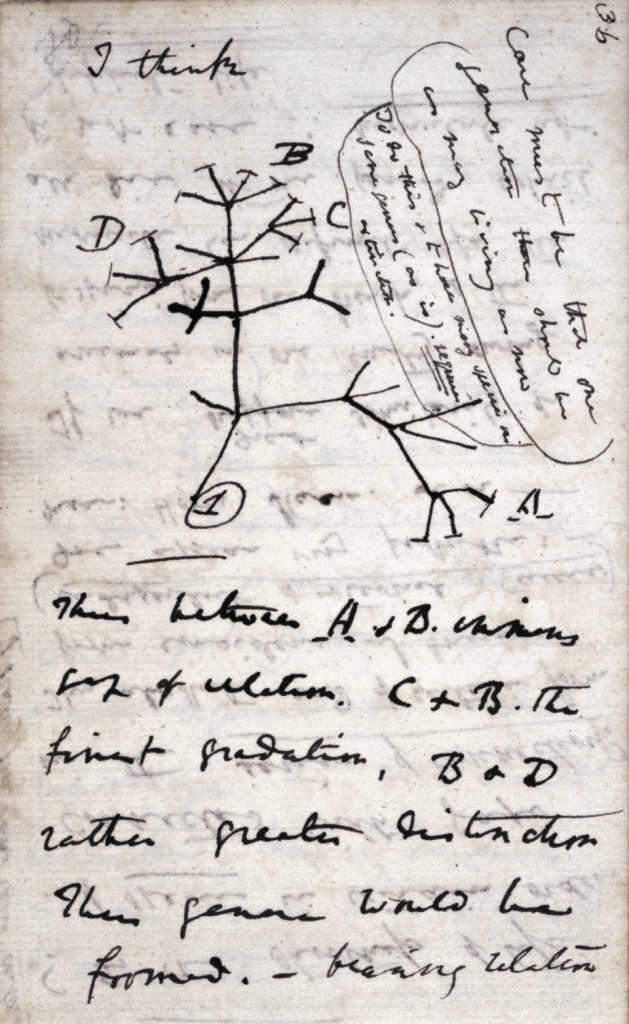
A scientific notebook can therefore perform several functions at once.
It stores observations, preserves details for later checking, and creates a space where separate pieces of information can be compared.
In this sense, the notebook becomes part of the thinking process. It does not replace reasoning. It provides a durable surface on which reasoning can continue.
From Personal Notebooks to the Second Brain
The materials used for personal notes have changed considerably, but many of the underlying problems remain familiar.
People still need to capture information before it disappears from memory. They still need to decide what is worth keeping, how to organize it, and how to find it again.
Today, one influential approach to these problems is often called a second brain.
The term commonly refers to an external system for collecting, organizing, and retrieving information so that a person does not have to rely entirely on memory.
In this sense, the idea has deep historical roots.
A commonplace book collected useful passages. A diary preserved experiences over time. A scientific notebook helped observations develop into explanations.
Modern digital tools can combine these functions while adding search, links, and connections between different kinds of information.
AI introduces another possibility.
Instead of requiring people to search through every note themselves, AI-assisted systems may help identify relevant information, summarize existing material, and connect ideas across different sources.
Recent developments, including Meta’s Muse personal AI agent and AI features in knowledge-management platforms such as Notion, suggest how personal information systems may increasingly become environments where people work with their recorded knowledge rather than simply store it.
These technologies are still evolving, and their usefulness depends on factors such as access permissions, information quality, and the reliability of AI-generated responses.
The important historical connection is not that a seventeenth-century commonplace book and an AI assistant are the same technology.
It is that both respond to a persistent human problem:
How can we preserve information today so that it becomes useful when we need it tomorrow?
The tools have changed. The need to remember, organize, retrieve, and use knowledge has not.
FAQ
When did people start using personal notebooks?
Personal record-keeping existed in various forms in ancient societies, including letters, accounts, and practical written records. The familiar bound paper notebook developed through a longer history of writing materials and bookmaking. There is no single date when personal notebooks began.
What is the difference between a commonplace book and a diary?
A commonplace book typically collects quotations, ideas, and other useful information, often organized by subject. A diary usually records events, experiences, or reflections in chronological order. In practice, historical notebooks sometimes combined both approaches.
Why were notebooks important for scientists?
Notebooks allowed scientists and other investigators to preserve observations, measurements, sketches, and developing ideas. They made it possible to compare information recorded at different times and reconsider earlier explanations. Surviving scientific notebooks can also help historians understand how research and discoveries developed.
Sources and Further Reading
Folger Shakespeare Library — Manuscripts
Folger Shakespeare Library — Commonplace Book, ca. 1650–1657
Folger Shakespeare Library — Shakespearean Extracts in an Oxford Commonplace Book
Darwin Online — Charles Darwin’s Manuscripts and Papers
Darwin Online — Darwin’s Notebooks on Geology, Transmutation, and Reading

