Long before books, libraries, or digital files existed, people faced a basic problem: human memory was not always enough.
A community could remember stories, customs, agreements, and obligations through speech. But as settlements grew and economic activity became more complicated, some information had to survive beyond a single conversation—or even beyond the lifetime of the person who remembered it.
How much grain had been collected? Who had received a certain amount of goods? What had been exchanged, owed, or stored?
Questions like these helped create a need for something more durable than memory.
The earliest forms of record-keeping were not simply early versions of books. They emerged from practical attempts to preserve information outside the human mind. Understanding that transition helps explain not only the origins of writing, but also why people still create records today.
Before Writing, People Still Had to Remember
Writing is relatively recent compared with the long history of human communication.
For most of human existence, knowledge was transmitted without written documents. Stories, traditions, skills, and social rules could be passed from one generation to another through speech, demonstration, ritual, and repeated practice.
Oral transmission can preserve remarkably complex knowledge. But it has limits when information must be counted, compared, verified, or retrieved precisely.
Imagine trying to manage a growing storehouse using memory alone. A person might need to remember how many containers of grain arrived, where they came from, how much had already been distributed, and what remained. As the number of people, goods, and transactions increased, keeping all of those details in memory became increasingly difficult.
This is one reason the history of records is closely connected with counting and administration.
Long before fully developed writing systems appeared, people used physical objects and marks to represent information. In the ancient Near East, for example, clay tokens have been studied as part of the development of systems for counting and accounting.
Scholars continue to debate the exact relationship between these objects and the later emergence of writing, so it is safer to see them as part of a broader evolution of information practices rather than as a single direct invention of writing.
The important change was conceptual: information could be represented outside the mind.
Once that happened, remembering no longer depended entirely on a person.
The First Records Were Often Practical
When early writing developed in Mesopotamia during the late fourth millennium BCE, many surviving early texts were administrative in nature.
They dealt with things such as commodities, labor, livestock, and distributions of goods.
That may seem surprisingly ordinary. We often associate writing with literature, philosophy, religion, or history. Yet some of the earliest written evidence reflects a much more immediate problem: keeping track of things.
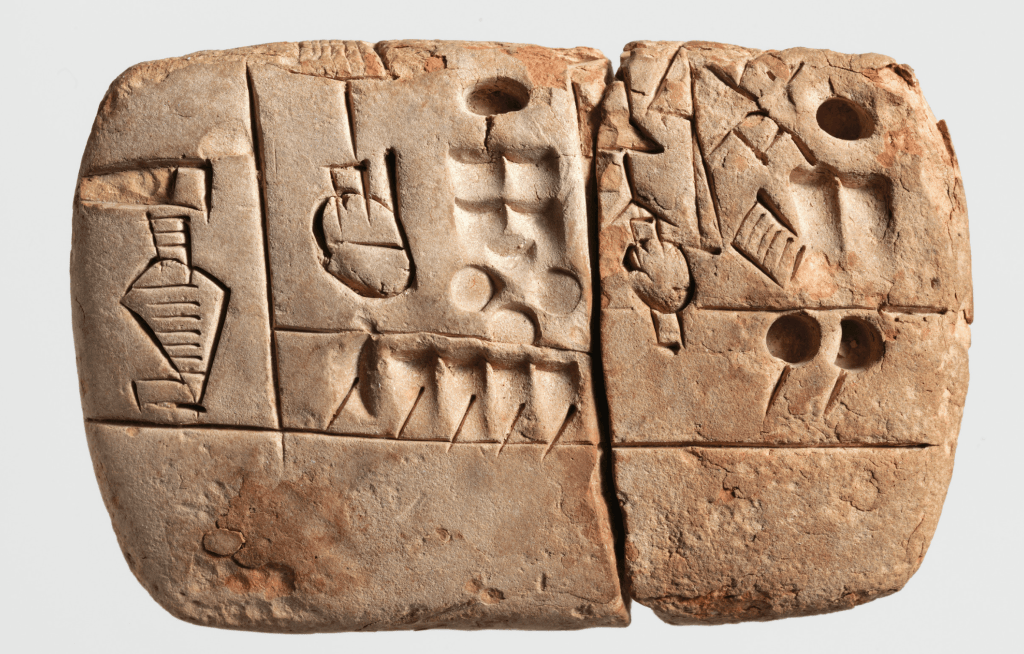
A clay tablet could preserve information after the people involved in a transaction had left. It could be stored, inspected, and compared with other records.
That changed the nature of information.
Spoken information exists primarily in the moment it is communicated. A durable record can remain after that moment has passed.
This made information more persistent.
A record could also become evidence. Instead of relying entirely on what someone remembered, a community or institution could refer to an external object containing marks that represented quantities, names, goods, or activities.
Record-keeping therefore did more than expand memory. It created a way to separate information from the person who originally knew it.
From Recording Quantities to Recording Language
Early record systems did not suddenly appear as complete writing systems. The transition took place gradually.
Marks and signs that represented objects or quantities became increasingly sophisticated. In Mesopotamia, the writing tradition that eventually developed into cuneiform changed considerably over time. Signs could represent not only things and numbers but also words, sounds, and more complex linguistic information.
This opened possibilities far beyond accounting.
Once a writing system could represent language more extensively, records could preserve many kinds of information: legal agreements, letters, religious texts, royal inscriptions, scholarly material, and literature.
The purpose of recording expanded from something like:
“How much grain is here?”
to questions such as:
“What agreement was made?”, “What happened?”, “What should another person know?”, “What knowledge should survive?”
This distinction matters because recording information and writing literature are not the same historical development, even though they eventually became deeply connected.
Writing transformed records from tools for managing immediate information into a medium through which knowledge could travel across both distance and time.
The Same Problem Still Exists Today
The materials have changed dramatically. Clay tablets became papyrus, parchment, paper, printed pages, computer files, databases, cloud documents, and digital notes. But many of the reasons people create records remain familiar.
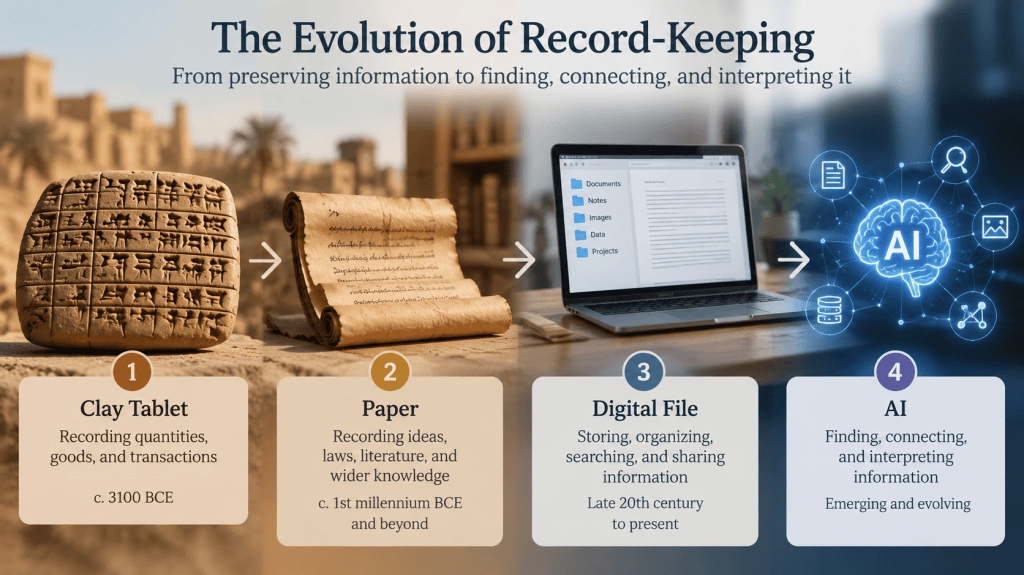
We record information because we do not want to depend entirely on memory. A shopping list prevents us from remembering every item. A calendar preserves future commitments. A receipt documents a transaction. Meeting notes preserve decisions after the conversation ends. A database allows thousands or millions of records to be searched and compared.
Even a short note on a phone performs an ancient function: moving information from human memory into an external system where it can survive and be retrieved later.
Modern record-keeping, however, introduces another problem.
Creating a record is easy. Finding it again may not be.
A person can accumulate thousands of emails, files, photographs, bookmarks, and notes. The challenge is no longer simply preserving information. It is organizing, retrieving, connecting, and deciding what information is useful.
That is why the history of record-keeping does not end with the invention of writing. Each major change in recording technology creates a new question.
Once humans learned how to preserve information, they had to learn how to organize it.
Once records became abundant, they had to learn how to find them.
Once records became digital, they had to learn how to connect and search enormous collections.
And as AI systems increasingly work with stored information, another question is emerging: what happens when our records are not only stored and retrieved, but also interpreted by machines?
Record-Keeping as an Extension of Memory
The beginning of record-keeping can be understood as a shift in where information lived.
Without an external record, information depends heavily on people remembering and transmitting it. With a record, some of that information can exist independently of any one person’s memory.
That simple change had enormous consequences.
Records made it possible to preserve transactions, decisions, laws, stories, observations, and knowledge across time. Later societies developed archives, libraries, catalogs, filing systems, databases, and search engines to manage the growing amount of recorded information.
The tools changed, but the underlying problem remained remarkably consistent:
How can information survive, and how can we find and use it when we need it again?
That question connects an ancient clay tablet to a modern digital note—and it is the question that continues throughout the history of record-keeping.
FAQ
Did writing begin only because people needed accounting records?
No. The development of writing was a complex historical process, and it should not be reduced to a single cause. Administrative and economic records are important among the earliest surviving evidence from Mesopotamia, but writing developed within broader social, political, religious, and cultural contexts. Different writing traditions also emerged in different parts of the world.
What is the difference between a record and writing?
A record is information preserved so that it can be referred to later. Writing is one method of representing language or information through visible signs. People can create records without a fully developed writing system, while writing can be used for purposes far beyond record-keeping, including literature and personal expression.
Why does ancient record-keeping matter in the digital age?
Because digital tools still address many of the same basic problems. We record information so it can survive beyond memory, then organize it so it can be retrieved and used. Files, databases, note-taking systems, search engines, and AI may be technologically different from clay tablets, but they belong to the much longer history of humans creating external systems for memory and knowledge.

