When we imagine an ancient clay tablet, it is easy to picture a mysterious text filled with stories, laws, or religious ideas.
But many of the earliest surviving tablets from Mesopotamia were concerned with something much more practical: keeping track of goods.
Grain had to be counted. Supplies had to be distributed. Workers received rations. Institutions needed ways to remember what had come in, what had gone out, and how much remained.
Clay tablets became part of a new solution to an old problem—how to preserve information when human memory was no longer enough.
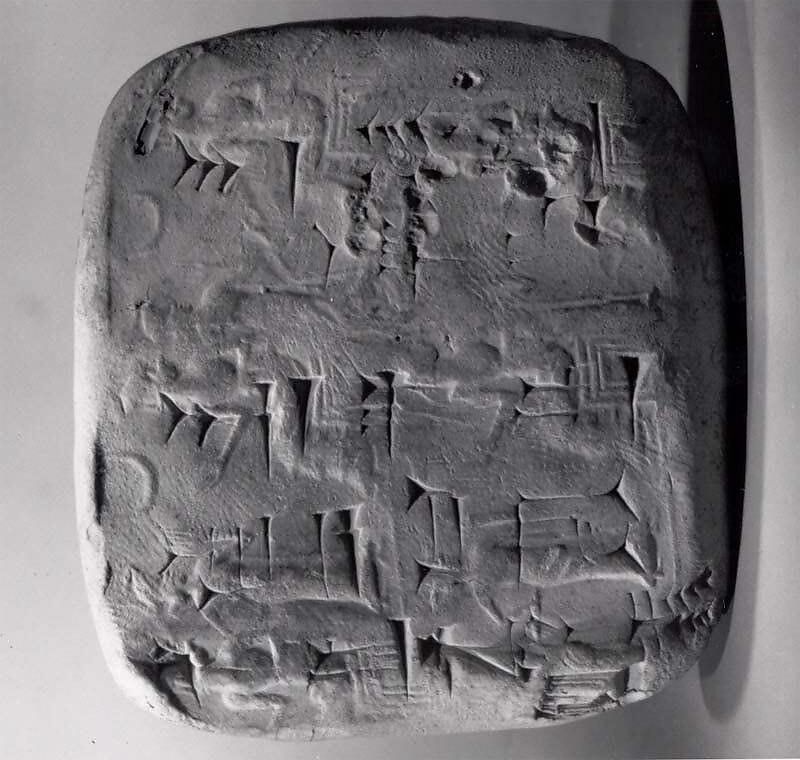
Why Was Clay Used for Records?
Southern Mesopotamia did not have the same natural resources as every other ancient region, but clay was readily available. That made it a practical material for recording information.
While clay was still moist, marks could be drawn or pressed into its surface. Once the tablet dried, those marks could remain. Tablets could be relatively small, handled individually, and stored with other records.
The material also shaped the way writing developed. Early signs were often drawn into clay. Over time, scribes increasingly used a reed stylus pressed into the surface. The resulting wedge-shaped impressions became characteristic of the writing system now known as cuneiform.
The word cuneiform describes the wedge-shaped appearance of the script rather than a particular language. Cuneiform was eventually used to write several languages over its long history.
But the earliest tablets belong to an earlier stage of that development. Scholars often call the signs on late fourth-millennium BCE tablets from southern Mesopotamia proto-cuneiform.
What Did the Earliest Tablets Actually Record?
Many early tablets were administrative records.
One surviving tablet from Mesopotamia, probably from Uruk and dated to about 3100–2900 BCE, appears to document the delivery and distribution of grain, including barley and emmer wheat.
Another tablet from the same general period records entries concerning malt and barley groats.
These are not stories written for entertainment. They are records created to help manage resources. That distinction tells us something important about the development of recording systems.
As settlements and institutions became larger, people needed to manage quantities of goods and labor that could be difficult to track through memory alone. A durable external record allowed information to remain available after the original transaction or distribution had taken place.
A tablet could answer practical questions:
How much grain was delivered? How much was distributed? What kind of commodity was involved? What quantity needed to be accounted for?
The earliest texts are not always easy for modern scholars to interpret precisely. Proto-cuneiform lacked many of the grammatical features that later writing could represent, so researchers must often reconstruct meaning from signs, numbers, context, and comparisons with other tablets.
That is why descriptions of individual early tablets frequently use cautious language such as “most likely” or “probably.”
From Pictures and Numbers to Cuneiform
Early Mesopotamian writing did not appear all at once in the familiar wedge-shaped form seen on later cuneiform tablets.
The system changed over time.
Some of the earliest tablets, dating to around 3300 BCE, used pictorial signs and numerical symbols to record economic information. By the following centuries, the forms and techniques of writing were changing.
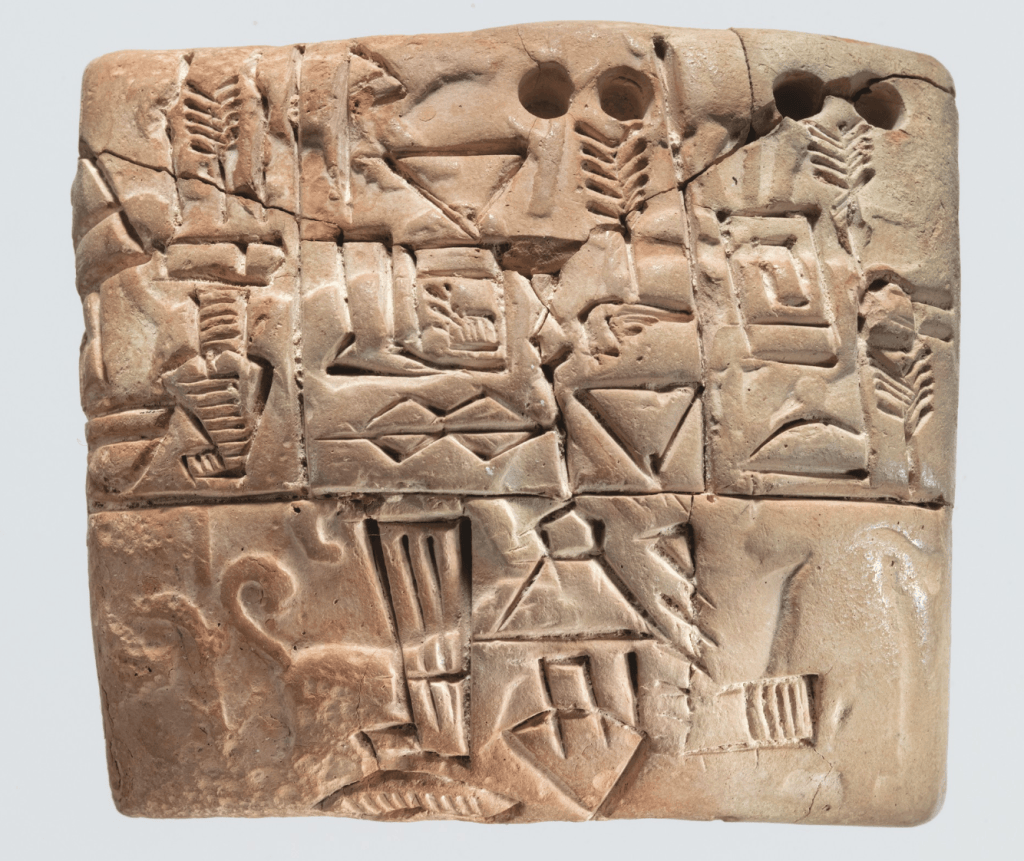
A sign could represent a commodity, while numerical signs represented quantities. This was extremely useful for accounting, but it was not yet the same as writing a complete spoken sentence.
As the system developed, signs became increasingly abstract and writing became capable of representing language more extensively. That transformation dramatically expanded what could be recorded.
Clay tablets eventually carried contracts, letters, legal documents, mathematical exercises, scholarly texts, religious works, and literature. Cuneiform was used for more than three thousand years and for several languages across the ancient Near East.
The humble administrative tablet was therefore part of a much larger transformation: records were becoming a medium for preserving increasingly complex forms of human knowledge.
What Clay Tablets Teach Us About Records Today
A clay tablet and a digital spreadsheet seem to have almost nothing in common.
One is made from earth and marked by hand. The other exists as digital data processed by computers.
Yet their underlying purpose can be surprisingly similar.
Imagine an ancient institution recording quantities of barley arriving and leaving a storehouse. Now imagine a modern organization tracking inventory in a database.
The technologies are radically different, but both systems attempt to answer the same fundamental questions:
What do we have? Where did it come from? Where did it go? How much remains?
This is one of the most persistent themes in the history of record-keeping.
New recording technologies do not eliminate the need to organize information. They create new ways to solve it.
Clay tablets made information durable outside human memory. Later materials made records easier to transport, copy, collect, and read. Eventually, paper and printing allowed records to multiply on a scale that ancient scribes could never have managed.
Digital technology would change the problem again.
But before records could become portable, searchable, or connected, humans first had to learn how to preserve information in a stable form.
In ancient Mesopotamia, clay provided one of the most important answers.
Sources & Further Reading
1. The Metropolitan Museum of Art — Proto-Cuneiform Tablet with Seal Impressions
2. The Metropolitan Museum of Art — Cuneiform Tablet: Shipment of Barley
3. The Metropolitan Museum of Art — Cuneiform Texts in The Metropolitan Museum of Art
Metropolitan Museum of Art Resources-PDF
4. The British Museum — How to Write Cuneiform, British Museum
FAQ
Were all Mesopotamian clay tablets accounting records?
No. Administrative and economic records are especially important among the earliest surviving tablets, but clay tablets were later used for a much wider range of material, including letters, contracts, legal texts, mathematics, scholarship, religious works, and literature.
Is proto-cuneiform the same as cuneiform?
Not exactly. Proto-cuneiform is the term commonly used for an early stage of writing in southern Mesopotamia before the script developed into later cuneiform. The forms of the signs and the ways they represented information changed considerably over time.
Why have so many clay tablets survived?
Clay can become very durable once it dries, and firing can make it even more permanent. As a result, clay records can survive for extremely long periods under favorable conditions. Their survival gives modern researchers an unusually direct view of administrative practices, writing, and knowledge in ancient Mesopotamia.

