Writing in ancient Mesopotamia was not a skill that could be picked up casually.
Cuneiform required writers to press carefully shaped marks into clay with a stylus. Over its long history, the script was used to record several languages and could involve hundreds of signs rather than a small alphabet like the one used for English today. British Museum
That complexity created a new problem. Once writing became important for administration, trade, literature, and other forms of record-keeping, societies needed people who could reliably read and produce those records.
The result was more than a writing technique. It was a system for teaching people how to create, copy, organize, and preserve written knowledge.
Learning to Write Meant Learning to Work with Clay
Before students could become skilled scribes, they had to become familiar with the physical process of writing.
A cuneiform tablet was not a blank sheet of manufactured paper. The writer worked with clay and impressed wedge-shaped signs into its surface with a stylus.
This meant learning how to form recognizable signs was itself an important part of scribal training. Archaeological objects give us unusually direct evidence of this process.
The Metropolitan Museum of Art holds a small Babylonian student exercise tablet dating to roughly the second millennium BCE. According to the museum, a teacher wrote a word or sign on one side and the student repeated the exercise on the other. On this particular tablet, the name of the deity Urash was copied six times. The Metropolitan Museum of Art
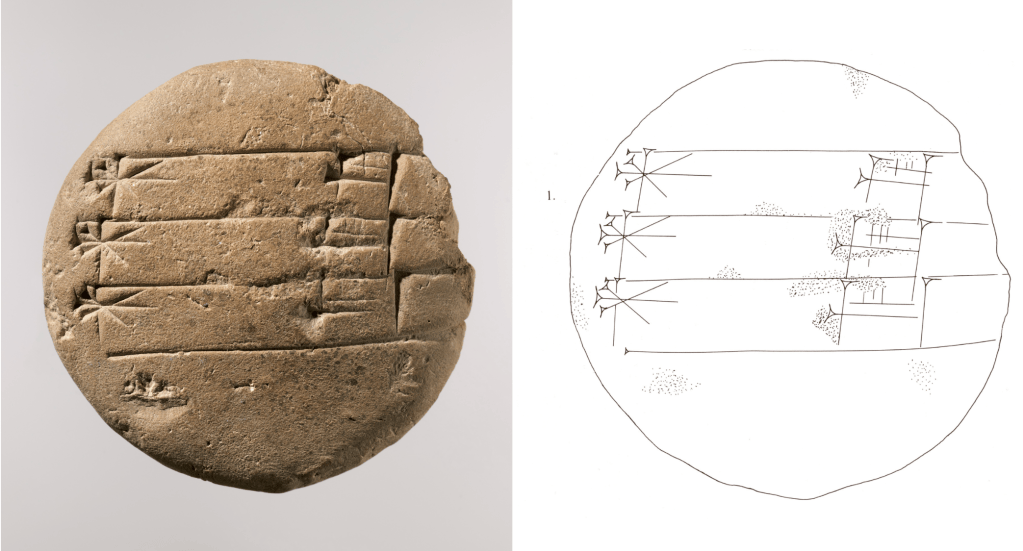
It is easy to recognize the basic principle. A modern student might practice the same letter across a page. A Mesopotamian student could practice signs by repeatedly pressing them into clay.
The technology was different, but repetition was already an important way of learning how to record information accurately.
From Individual Signs to Lists and Texts
Learning the shape of individual signs was only the beginning.
As students progressed, scribal education involved copying and memorizing increasingly complicated material. Evidence from surviving school tablets shows exercises ranging from elementary sign practice to longer compositions. World History Encyclopedia
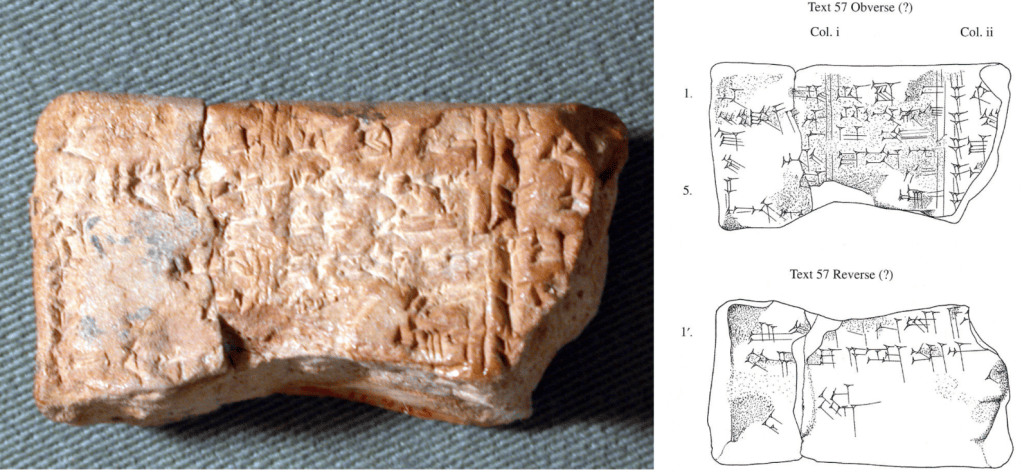
Lists were especially useful. A list could organize words into a form that could be copied, compared, and memorized. Students encountered vocabulary connected with animals, plants, professions, places, objects, and other subjects.
This is significant for the history of records.
A written list does more than preserve individual words. It places information into an organized structure. The student therefore was not simply learning how to make marks in clay. Scribal training also transmitted established ways of arranging knowledge.
More advanced students could move on to proverbs, literary compositions, and specialized material.
In other words, learning to write gradually became inseparable from learning how earlier generations had recorded information.
Who Became a Scribe?
Literacy in ancient Mesopotamia should not be imagined as something distributed across society in the same way that basic literacy is expected in many societies today.
Scribal literacy required specialized training and should not be imagined as something distributed across Mesopotamian society in the same way that basic literacy is expected in many societies today. Learning cuneiform involved sustained practice with signs, words, lists, and increasingly specialized written material.
The institutions and settings in which scribes were trained also changed across Mesopotamia’s long history. The Sumerian term edubba, often translated as “tablet house,” is associated with scribal education, but it would be misleading to imagine one standardized school system operating unchanged everywhere for thousands of years.
What remained important was the specialized nature of scribal knowledge.
Writing was useful because Mesopotamian societies increasingly depended on records.
Administrative accounts could track goods and resources. Letters could carry information across distance. Legal and economic documents could preserve transactions and obligations. Religious, scholarly, and literary texts could transmit knowledge beyond a single conversation or lifetime.
Someone had to produce and interpret those records. That made the scribe more than a person with good handwriting. Scribal skill connected the physical act of writing with the institutions that depended on written information.
Scribal Training Helped Knowledge Survive
There is another reason scribal education matters.
A writing system survives only if people continue to learn it.
Imagine that a community creates thousands of records but stops teaching the next generation how to read and reproduce the writing system. The tablets might physically survive, but their usefulness would decline as knowledge of the script disappeared.
Training provided continuity.
Students copied signs that earlier scribes had used. More advanced learners copied vocabulary, proverbs, and compositions. In doing so, they were not merely completing exercises. They were reproducing a body of recorded knowledge.
Some of the school exercises that survive today are especially valuable because mistakes, repetitions, and copying patterns can reveal parts of that learning process.
A small practice tablet may therefore tell us something surprisingly important: records depend not only on a medium for storing information, but also on people who know how to interpret and reproduce it.
That principle extends far beyond ancient Mesopotamia.
Libraries need systems that allow their collections to be understood. Archives need people who know how records are organized. Digital information depends on formats, software, conventions, and skills that allow later users to retrieve it.
The tools have changed enormously, but preservation has never been only about keeping an object intact. It is also about preserving the knowledge required to use the information stored within it.
FAQ
What was a Mesopotamian scribal school called?
The Sumerian term edubba is commonly translated as “tablet house” and is associated with scribal education. Evidence for scribal training comes from school exercises, literary texts about education, and archaeological discoveries from different periods and locations in Mesopotamia. World History Encyclopedia
Did students really practice cuneiform on clay tablets?
Yes. Surviving exercise tablets provide direct evidence of scribal practice. Some small tablets contain signs or words written as exercises, including examples in which a student copied a form provided by a teacher. The Metropolitan Museum of Art
Why were scribes important to the history of record-keeping?
Creating a writing system was only part of the development of written records. Societies also needed people capable of reading, copying, and producing those records. Scribal training helped transmit both writing skills and recorded knowledge from one generation to another, allowing written information to remain useful long after it was first created.
Sources & Further Reading
- The Metropolitan Museum of Art — “Cuneiform tablet: student exercise tablet.” An Old Babylonian student tablet showing how scribes practiced signs and words by copying a teacher’s example.
The Met — Student Exercise Tablet - ORACC (Open Richly Annotated Cuneiform Corpus) — “The Old Babylonian School.” An academic resource on scribal education, the edubba, school texts, and the Old Babylonian scribal curriculum.
ORACC — The Old Babylonian School - The Metropolitan Museum of Art — “Cuneiform tablet: school exercise tablet, Urra=hubullu, tablet 1.” A later Mesopotamian school exercise tablet connected with the lexical-list tradition discussed in this article.
The Met — Urra=hubullu School Exercise Tablet - The British Museum — “How to write cuneiform.” An accessible introduction to how cuneiform signs were impressed into clay and how the writing system worked.
British Museum — How to Write Cuneiform

