The earliest clay tablets from Mesopotamia were remarkably useful, but they had an important limitation.
They could record quantities of grain, animals, and other goods. They could help administrators keep track of resources. But recording a transaction is not the same as recording everything people can say.
A list of commodities and numbers does not easily preserve a conversation, a legal argument, a prayer, or a story.
For writing to become capable of doing those things, signs had to do more than identify objects and quantities. They also had to represent language.
That transformation did not happen at a single moment. Over centuries, the recording systems of ancient Mesopotamia developed into cuneiform—a writing tradition capable of preserving increasingly complex forms of human thought.
The Earliest Signs Were Designed for Practical Records
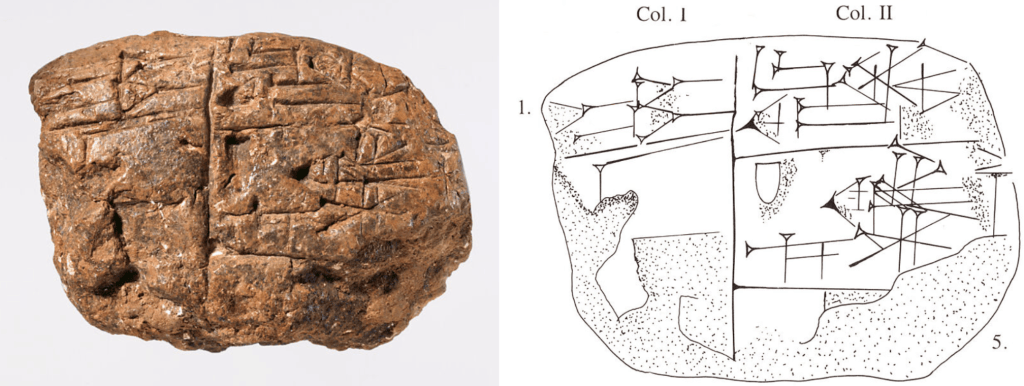
Some of the earliest known writing from southern Mesopotamia appeared in the late fourth millennium BCE.
Many surviving tablets from this period are administrative. They contain numerical systems and signs associated with commodities, labor, and institutional activities. This made them effective tools for accounting.
A sign could help identify what was being counted, while numerical signs indicated quantities. In this context, a record did not necessarily need to reproduce a complete spoken sentence. It needed to preserve enough information for people working within the same administrative system to understand it.
Modern scholars generally refer to this early stage as proto-cuneiform.
Its importance lies not only in its age. Proto-cuneiform shows that writing emerged through a gradual process in which people experimented with ways of turning information into visible, durable signs.
But as those signs were used for more purposes, the system began to change.
When Signs Began to Represent Language
One of the most important developments was the use of signs for their connection to spoken words and sounds.
Imagine a sign that originally represents a particular object. If the spoken word for that object shares a sound with another word, the sign can potentially be used for its sound rather than only for the original object. This kind of change greatly expands what a writing system can express.
Instead of requiring a completely different picture for every idea, writers can combine signs in ways that reflect elements of spoken language.
Mesopotamian writing developed in this direction gradually. Signs could function in different ways: some represented words or ideas, while others could contribute phonetic information. Additional signs could also help readers identify the category or meaning of a word. This made the system much more flexible than a collection of pictures.
Writing was becoming capable not merely of counting things, but of representing language.
Why Did Cuneiform Become Wedge-Shaped?
The appearance of the writing changed along with the system itself. Early signs could be drawn into soft clay, and some were more pictorial in appearance. Over time, scribes increasingly created signs by pressing a reed stylus into the clay. The tip and edges of the stylus produced characteristic impressions.
These wedge-shaped marks are the reason modern scholars use the name cuneiform, from a Latin term associated with a wedge.
The signs also became more abstract. Someone looking at a later cuneiform tablet cannot simply interpret the text by recognizing pictures of the objects being discussed. Learning to write therefore required knowledge of a complex system of signs and conventions.
Cuneiform was not a language itself. It was a writing system, and over its long history it was adapted to write several languages, including Sumerian and Akkadian. That adaptability helped cuneiform remain in use for thousands of years across different parts of the ancient Near East.
Writing Changed What a Record Could Preserve
Once writing could represent language more extensively, the range of possible records expanded dramatically.
Clay tablets continued to serve administrative purposes, but they could also preserve contracts, letters, legal texts, mathematical exercises, scholarly works, religious compositions, and literature.
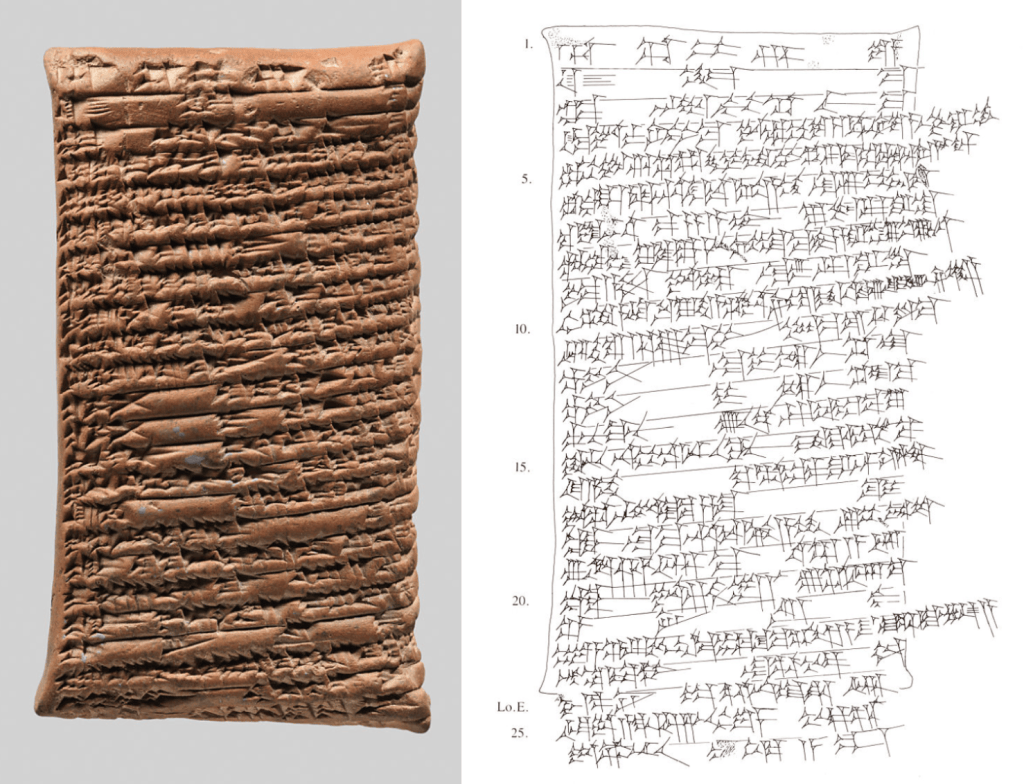
This changed the role of the record.
A record could now preserve not only how much grain had been delivered, but also agreements between people, messages sent across distances, calculations, instructions, and texts intended to be read again.
The distinction matters even today.
A spreadsheet can record quantities extremely well. A database can preserve structured information about thousands or millions of items. But neither format alone is designed to capture every kind of human expression.
Different recording systems make different kinds of information possible—or easier—to preserve.
The development of cuneiform demonstrates an early version of this principle.
The history of writing was therefore not simply a progression from crude symbols to better-looking letters. It was a gradual expansion in what a record could represent.
As records became capable of preserving more kinds of information, another problem inevitably followed.
The more records a society accumulated, the more important it became to decide who would create them, how they would be organized, and how people could learn to read and write them.
That would make the scribe one of the most important figures in the history of record-keeping.
Sources & Further Reading
The Metropolitan Museum of Art — Cuneiform tablet: Late Babylonian grammatical text
The Metropolitan Museum of Art — Proto-cuneiform administrative tablet
The British Museum — How to write cuneiform reed stylus
FAQ
Was cuneiform the first writing system?
Cuneiform developed from some of the earliest known writing traditions in Mesopotamia, but describing any single system as simply “the first writing” can oversimplify the evidence. Early writing developed over time, and scholars continue to study how different early recording and writing systems emerged.
Is cuneiform a language?
No. Cuneiform is a writing system rather than a language. It was used to write multiple languages over its long history, including Sumerian and Akkadian.
Why was the development of cuneiform important for record-keeping?
It greatly expanded what written records could preserve. Systems that were initially especially useful for administration and accounting developed into forms of writing capable of recording language, allowing people to preserve letters, contracts, scholarship, literature, and many other kinds of information.

