For thousands of years, people have adapted the materials around them to preserve information.
In ancient Mesopotamia, clay became one of the most important surfaces for writing. It was readily available, could be shaped into tablets, and—under the right conditions—could survive for an extraordinarily long time.
Ancient Egypt developed a different solution. Along the Nile grew papyrus, a tall wetland plant whose inner stalk could be processed into a smooth writing surface. Sheets could be joined together to form rolls, written on with ink, folded or rolled, and carried from place to place. The Metropolitan Museum of Art describes papyrus as Egypt’s primary writing surface and explains that longer scrolls were produced by joining multiple sheets together. * The Metropolitan Museum of Art
Papyrus did more than provide another surface for writing. Its physical properties helped shape what a record could look like, how it could travel, and how much information could be kept together.
From a Clay Tablet to a Flexible Writing Surface
Clay and papyrus required very different ways of writing.
A Mesopotamian scribe could press a stylus into wet clay to create signs. An Egyptian scribe working on papyrus instead used ink and a reed writing tool.
Papyrus itself was manufactured from the stalk of the plant. The tough outer layer was removed, and thin strips from the inner material were arranged in layers. One layer was placed beside another, while another layer crossed it. The layers were pressed together and dried to create a sheet suitable for writing. The Metropolitan Museum of Art
That difference mattered.
A clay tablet was a relatively rigid object. Papyrus was a flexible sheet. Multiple papyrus sheets could also be joined to produce a much longer writing surface.
This did not mean that papyrus simply “replaced” clay across the ancient world. Different regions developed their own writing traditions and continued to use materials suited to their environments and institutions.
But papyrus made a different physical form of record possible.
Instead of treating every record as a separate tablet-sized object, writers could create documents that extended across multiple connected sheets. The record itself could become longer.
Records Became Easier to Carry
One of the most important characteristics of papyrus was portability.
A written message no longer had to exist as a rigid tablet. A sheet of papyrus could be folded, addressed, transported, and opened by its recipient.
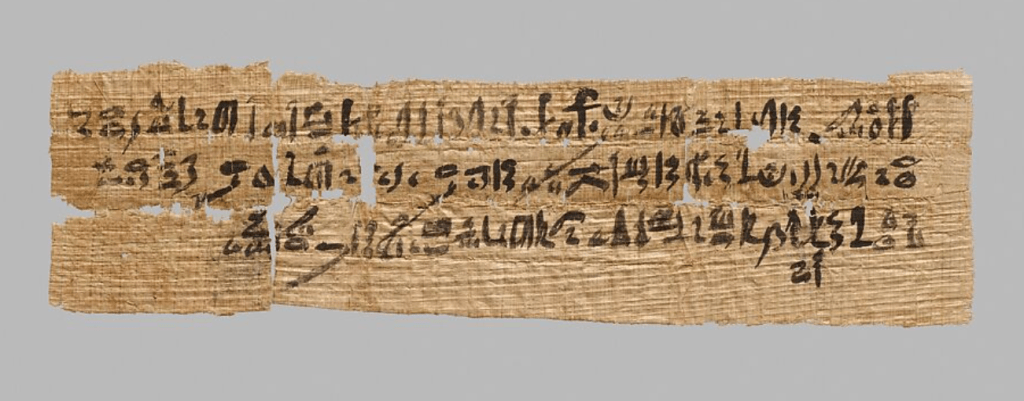
A surviving Egyptian letter at The Metropolitan Museum of Art provides a remarkably direct example. Dating to approximately 1473–1458 BCE, the letter was written in hieratic script on papyrus. The museum notes that it was folded and that the recipient’s address was written on the back. The Metropolitan Museum of Art
That small detail tells us something important about records.
Information was not only being stored. It was moving.
A record could travel from one person to another while preserving a message beyond the moment in which it was spoken.
Papyrus was also used for administrative and economic information. Surviving examples include accounts, records concerning land and commodities, and correspondence. One papyrus fragment in The Met’s collection contains both a letter and records connected with the cultivation of royal lands, while smaller texts mention commodities and quarrying activity. The Metropolitan Museum of Art
The material therefore supported many kinds of information—from practical administration to personal communication.
Longer Records Changed How Information Could Be Organized
The ability to connect sheets had another consequence.
Papyrus could become a scroll.
Instead of squeezing a complete record onto one small surface, a writer could extend a document by adding more sheets. The Met notes that longer scrolls were created by gluing sheets together and that the papyrus scroll became a major book form in antiquity. The Metropolitan Museum of Art
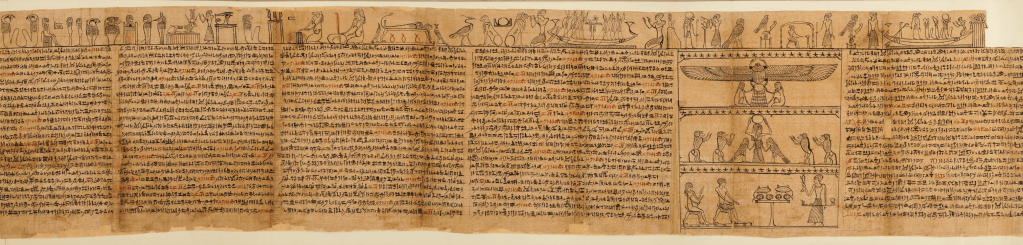
This opened possibilities beyond short administrative records.
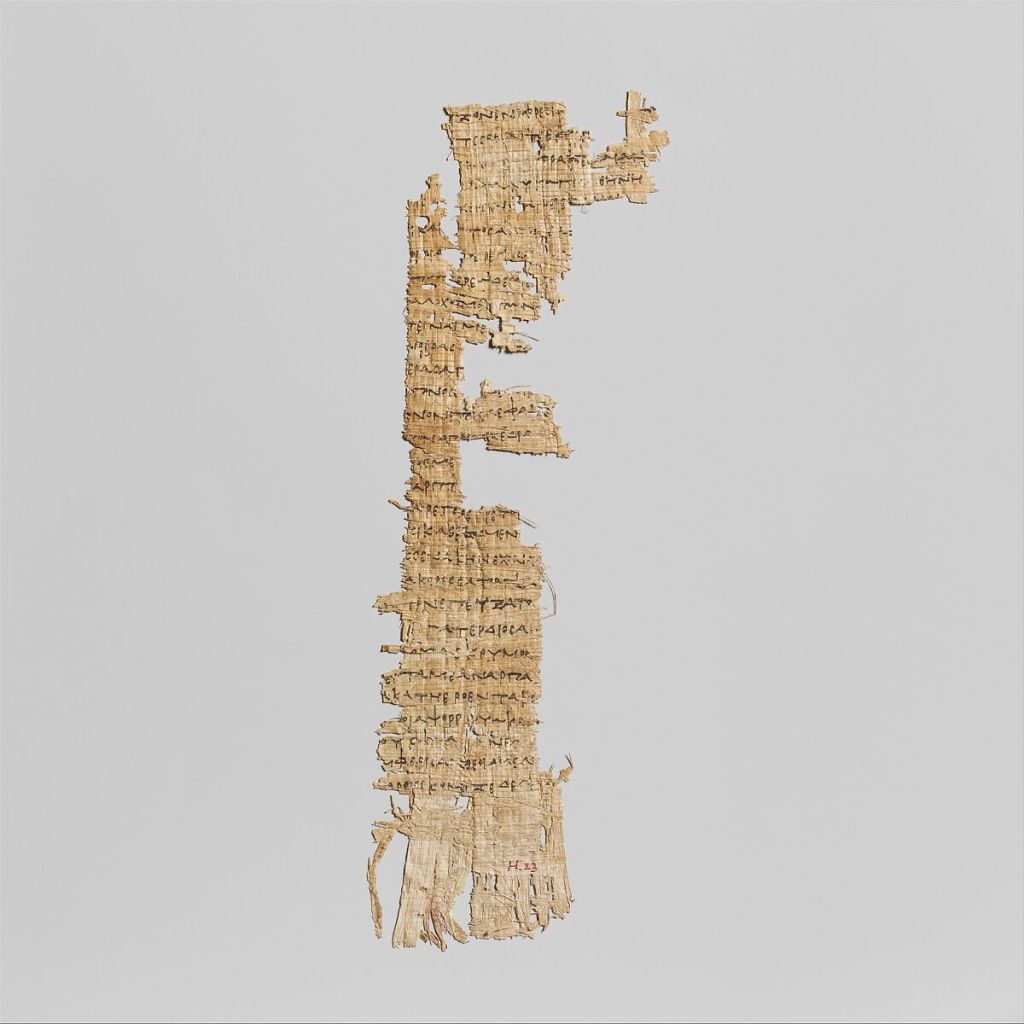
Longer religious, literary, legal, scholarly, and documentary texts could be preserved as extended written works. Centuries later, papyrus was also used throughout the Mediterranean world. A surviving Ptolemaic papyrus at The Met, dating to around 285–250 BCE, preserves lines from Homer’s Odyssey. The Metropolitan Museum of Art
The importance of this change is easy to overlook today. We are accustomed to documents whose length is almost unlimited. A word-processing file can contain one page or a thousand without changing its basic physical form.
Ancient records were constrained much more directly by their materials. The dimensions, weight, flexibility, and construction of a writing surface influenced what writers could conveniently record and how that information could be arranged.
Papyrus expanded those possibilities.
A Useful Record Was Still a Valuable Object
Papyrus was convenient, but it should not be imagined as ancient disposable paper.
The material had value.
The Met describes an Egyptian papyrus from around 1181 BCE that contains writing on both sides and notes that papyrus documents whose original contents were no longer needed could be retained and reused as writing material. The Metropolitan Museum of Art
Other surviving fragments also show papyrus being reused. The Metropolitan Museum of Art
This gives us a useful reminder about the history of information.
The cost and availability of a recording medium influence how people use it.
When writing surfaces are valuable, old documents can become new writing space. When storage is physically limited, writers and institutions must decide what deserves to be kept. When copying requires human labor, preserving information involves choices that are largely invisible in an age of inexpensive digital duplication.
Papyrus changed what was possible, but it did not eliminate those constraints. It simply created a new balance between durability, portability, length, cost, and convenience.
From Recording Information to Moving Knowledge
The history of papyrus is therefore about more than an ancient precursor to paper.
Its importance lies partly in what its physical form allowed people to do with recorded information.
A sheet could carry a letter.
Several sheets could become a scroll.
Administrative information could be written, transported, stored, consulted, and sometimes reused. Longer works could remain together as extended texts.
This is a recurring pattern in the history of record-keeping.
When the medium changes, people do not merely write the same information on a different surface. New materials can alter the size, movement, organization, and use of records themselves.
Clay helped early societies preserve information in durable physical objects. Papyrus offered another possibility: records that could become lighter, flexible, and extended across connected sheets.
And once records could move more easily, knowledge could move with them.
FAQ
Was papyrus the same as modern paper?
No. Papyrus and paper are produced differently. Papyrus sheets were made from strips taken from the papyrus plant and arranged in layers, while traditional paper is made from plant fibers that are broken down into pulp and then formed into sheets. They can serve similar purposes as writing surfaces, but they are different materials.
Did ancient Egyptians use papyrus only for important religious texts?
No. Surviving papyri include letters, administrative documents, accounts, literary works, and other kinds of writing. One New Kingdom example in The Met’s collection is an ordinary letter, while another surviving document contains administrative information relating to land, commodities, and other activities. The Metropolitan Museum of Art
Did papyrus eventually disappear?
Not immediately. Papyrus remained an important writing material for a very long period and spread well beyond pharaonic Egypt. Other writing materials, including parchment, became increasingly important, and the codex gradually replaced the scroll as the dominant book form in late antiquity. Paper later became widespread in Egypt as well. The Metropolitan Museum of Art
Sources and Further Reading
The Metropolitan Museum of Art — Letter Written in Hieratic Script on Papyrus
The Metropolitan Museum of Art — Hieratic Papyrus Fragment
The Metropolitan Museum of Art — Papyrus Fragment with Lines from Homer’s Odyssey
The Metropolitan Museum of Art — Papyrus Sheet and Scribe’s Writing Materials

