For most of the history of writing, making another copy of a text meant doing much of the work again.
A scribe copying a manuscript had to reproduce its words line by line. Even when a writing material such as paper made records easier to produce and transport, every additional copy still demanded time, attention, and skilled labor.
Printing changed this relationship between effort and repetition.
Instead of treating every copy as a new act of writing, printers could prepare a reusable surface—or eventually reusable pieces of type—and use it to produce the same text again and again.
That change did not begin with a single inventor or in a single place. Printing technologies developed over centuries, particularly in East Asia, before movable-type printing transformed book production in Europe. The important change was not simply that books could be made faster. Reproduction itself became a system.
Woodblock Printing Made Repetition the Point
One of the most important early printing methods was woodblock printing.
The principle was straightforward. Text or an image could be prepared on a wooden block, with the areas that were not meant to print carved away. Ink was applied to the remaining raised surface, and paper was pressed or rubbed against it to produce an impression.
Creating the block required considerable work. But once it had been prepared, the same block could produce multiple copies. That was fundamentally different from copying a manuscript by hand.
The Metropolitan Museum of Art notes that printing on paper developed in China around 700 CE, with surviving material from Dunhuang documenting the early development of woodblock printing from the late seventh century onward. Buddhism played an important role in this development because reproducing religious texts and images was itself culturally significant.
Printing also offered another advantage: repeated copies could be produced from the same prepared surface.
A hand-copied text could accumulate differences each time it was reproduced. A printing block did not eliminate mistakes—the block itself could contain them—but once prepared, it allowed many impressions to be made from the same design.That made repetition one of the defining features of the technology.
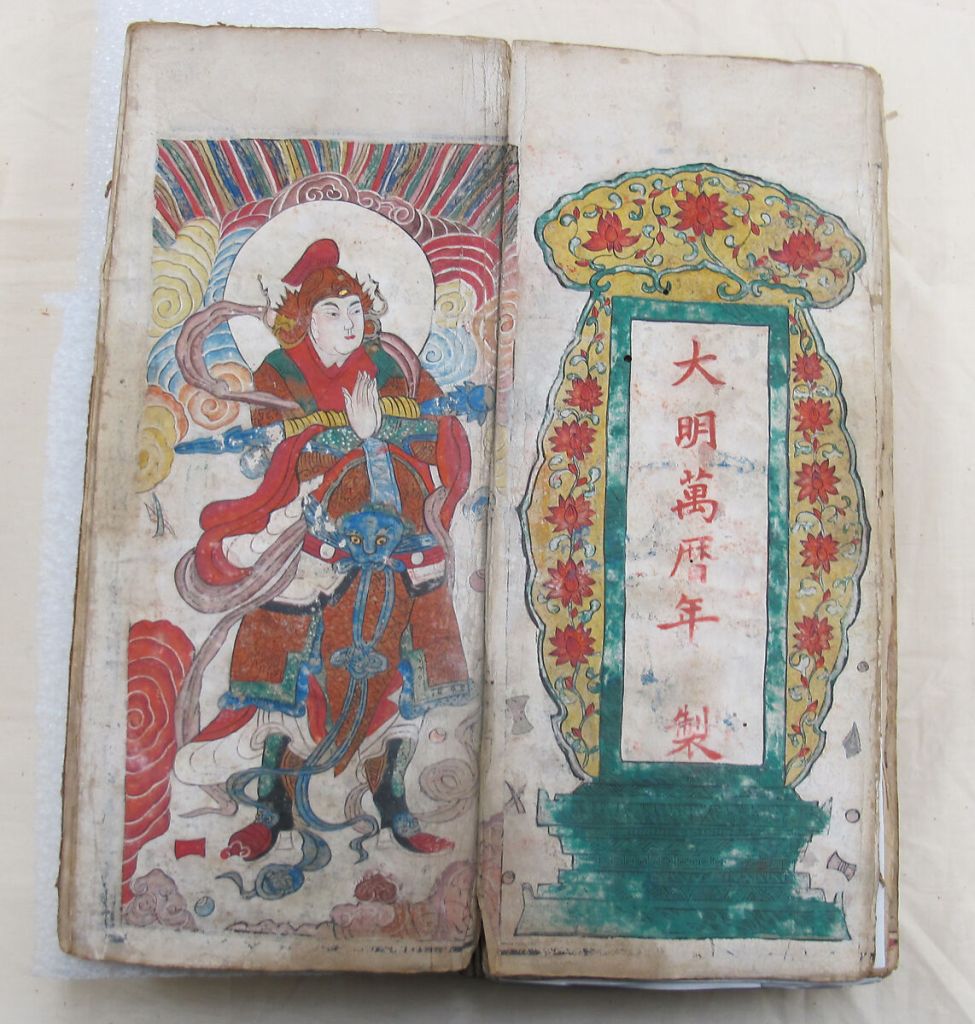
Woodblock printing remained useful long after other printing technologies appeared. A block preserved an entire page or design as a single reusable object, making it particularly practical when the same material needed to be printed repeatedly.
But another approach would change the structure of printing itself.
Movable Type Separated the Text into Reusable Pieces
A woodblock treats a page as a single printing surface.
Movable type breaks that surface apart.
Instead of carving an entire page permanently into one block, individual characters can be made as separate pieces, arranged to form a page, printed, and then rearranged for another text.
In eleventh-century China, Bi Sheng developed a system of movable type using individual ceramic characters. The idea introduced a different relationship between writing and reproduction: the components of a page could themselves become reusable.
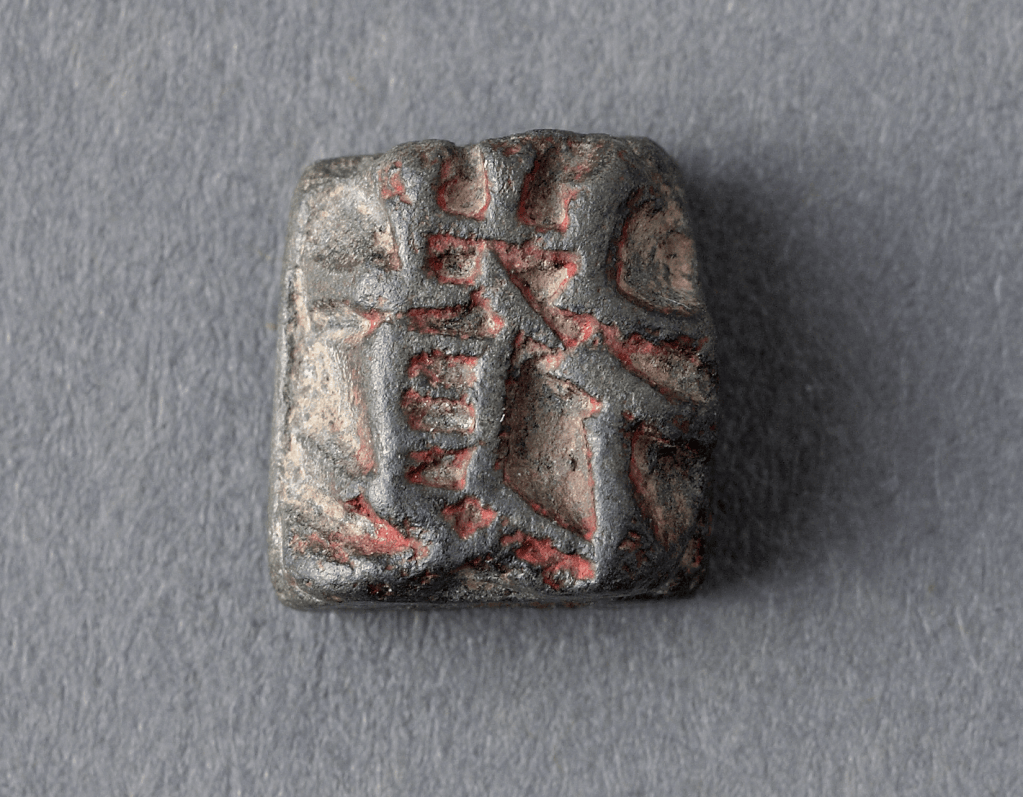
The technology also developed in Korea, where printers made an important further advance: movable type cast in metal. During the Goryeo dynasty, metal movable type was already being used by the early thirteenth century. Historical evidence records a work on Confucian ritual printed with movable metal type around 1234.
Surviving pieces of Goryeo metal type provide physical evidence of Korea’s early movable-type technology. A character was no longer necessarily part of a permanently carved page. It could exist as an individual printing component that could be arranged with others and reused.
Another important piece of evidence is Jikji, a Korean Buddhist text printed at Heungdeoksa Temple in Cheongju in 1377.
Today only the second volume of the metal-type edition survives. UNESCO recognizes Jikji as the oldest surviving book printed with movable metal type. Its importance lies not in being the beginning of Korean metal-type printing—the technology was already older—but in being the earliest surviving book that provides direct evidence of that tradition. UNESCO
Movable type, however, did not simply make woodblock printing obsolete.
The practical value of movable type depended on factors such as the writing system, the number of characters required, the size of a print run, and the kind of material being produced. East Asian printers continued using woodblocks alongside movable-type technologies for centuries.
The history of printing, therefore, is not a simple sequence in which one invention immediately replaced another. Different methods solved different problems.
Gutenberg Changed Printing in Europe
By the fifteenth century, another major development was taking place in Europe.
Johannes Gutenberg and his collaborators developed a printing system that brought together reusable metal type, suitable inks, and a mechanical press. The significance of Gutenberg’s work was not that he invented printing itself. Printing and movable metal type already had histories in East Asia.
His importance lies in the system of movable-type printing that emerged in fifteenth-century Europe and the expansion in European book production that followed.
The most famous product associated with this system is the Gutenberg Bible, printed in Mainz around 1454–1455.
The Library of Congress specifically cautions against calling it the world’s first printed book because movable metal type had already been used in Korea. It describes the Gutenberg Bible more accurately as the first book printed with movable metal type in Western Europe; its research guide also identifies it as the first large-format typographic book produced in Europe. The Library of Congress
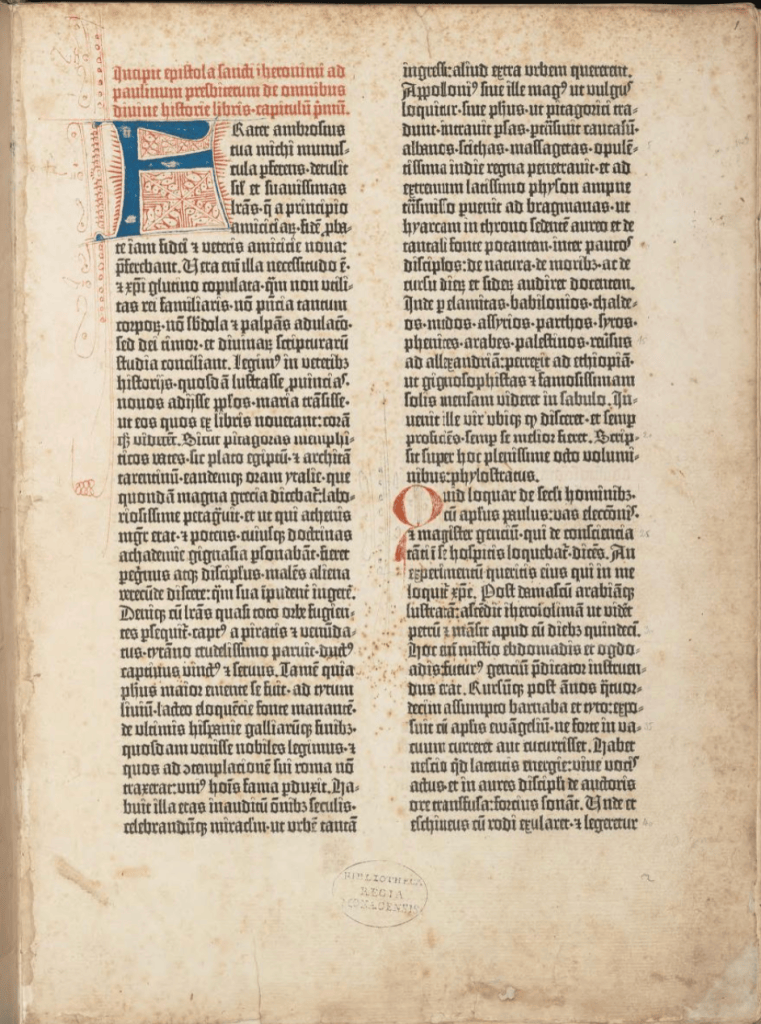
The Gutenberg Bible also reminds us that early printing was not entirely mechanical in the modern sense.
Printed pages could still receive work by hand. Decoration, rubrication, and other finishing could vary from copy to copy. Gutenberg originally planned to print some headings in red but instead used a model that allowed those elements to be added by hand. The Library of Congress
Printing therefore did not instantly eliminate manuscript practices.
For a time, the printed book was partly a product of the older manuscript world and partly a product of a new system of reproduction.
Printing Made Copies More Consistent—and More Numerous
The deepest change brought by printing was not simply speed.
It changed where the work of copying happened.
With manuscript copying, much of the labor had to be repeated for every new copy. A second manuscript required another copying process. A third required another.
Printing concentrated more labor at the beginning.
A woodblock had to be carved. Movable type had to be produced, selected, arranged, inked, and printed. A press and a workshop required equipment and skilled workers.
But once the printing surface had been prepared, producing additional impressions became a different kind of task.
The economics of reproduction began to change.
The Gutenberg Bible illustrates both the possibilities and the limits of early European printing. The Library of Congress reports that approximately 180 copies are believed to have been produced, although that estimate is based on historical evidence rather than a surviving production record. Most were printed on paper, while others were printed on vellum. The Library of Congress
That was still a small number by modern publishing standards. But compared with producing every copy as a separate manuscript, the underlying principle was transformative. The same prepared text could generate many copies.
When Copies Multiply, Information Travels Differently
Each major recording technology changed a different part of the problem of preserving knowledge.
Clay tablets gave written records remarkable durability. Papyrus made long written documents lighter and more portable. The codex divided long texts into pages that could be turned, revisited, and compared. Paper provided a flexible writing surface that could be produced and used across an expanding range of contexts.
Printing changed something else: the scale of repetition.
Once a text could be reproduced through a prepared printing system, the relationship between one document and its copies changed.
A record no longer had to remain a unique object—or one of a small number of painstakingly copied manuscripts. More people could encounter versions produced from the same printing process, and texts could circulate across wider networks.
This did not happen everywhere at the same speed, and printed books did not immediately become cheap or universally accessible.
But the direction had changed.
For thousands of years, one of the central challenges of record-keeping had been how to preserve information.
Printing increasingly introduced another problem.
What happens when there are so many recorded texts that finding the right one becomes difficult?
As collections grew, libraries needed better catalogs. Books needed systems of organization. Readers needed ways to locate one work among many.
The history of records was beginning to move from the problem of making copies to the problem of finding information among copies.
FAQ
Did Gutenberg invent printing?
No. Printing had developed in East Asia centuries before Gutenberg. The Metropolitan Museum of Art dates printing on paper in China to around 700 CE, and movable metal type was used in Korea before Gutenberg’s fifteenth-century work. Gutenberg’s historical importance lies in the movable-type printing system developed in Europe and its major role in the expansion of European book production. The Metropolitan Museum of Art
What is the difference between woodblock printing and movable type?
In woodblock printing, a complete page, text, or image can be carved into a block and printed repeatedly from that surface. Movable type instead uses individual characters that can be arranged into a page, taken apart after printing, and reused in new combinations. Neither method automatically replaced the other; their usefulness depended on the writing system, production needs, and printing context.
Was the Gutenberg Bible the first printed book?
No. Printed works existed in East Asia centuries earlier, and Korea used movable metal type before Gutenberg. The Gutenberg Bible, produced in Mainz around 1454–1455, is more accurately described as the first major book printed with movable metal type in Western Europe, rather than the world’s first printed book. The Library of Congress
Sources and Further Reading
The Metropolitan Museum of Art — The Printed Image in China, 8th–21st Century
The Metropolitan Museum of Art — Korea, 1000–1400 A.D.
National Museum of Korea — Goryeo Metal Movable Type
UNESCO Memory of the World — Baegun hwasang chorok buljo jikji simche yojeol (Jikji)
Bibliothèque nationale de France — “Jikji,” a Treasure of the World of Printing
Library of Congress — The Gutenberg Bible
Library of Congress — The Gutenberg Bible: A Resource Guide

